



Americans have lost faith in many of the nation's core institutions. What’s more, the partisan divide has never been wider.
Back in the mid-1960s, near the end of the American High, roughly 70% to 80% of Americans trusted major institutions, including the federal government, to do what was right. By the late 1970s, following Watergate and the withdrawal from Vietnam, trust had already fallen sharply. But the decline didn't stop there.
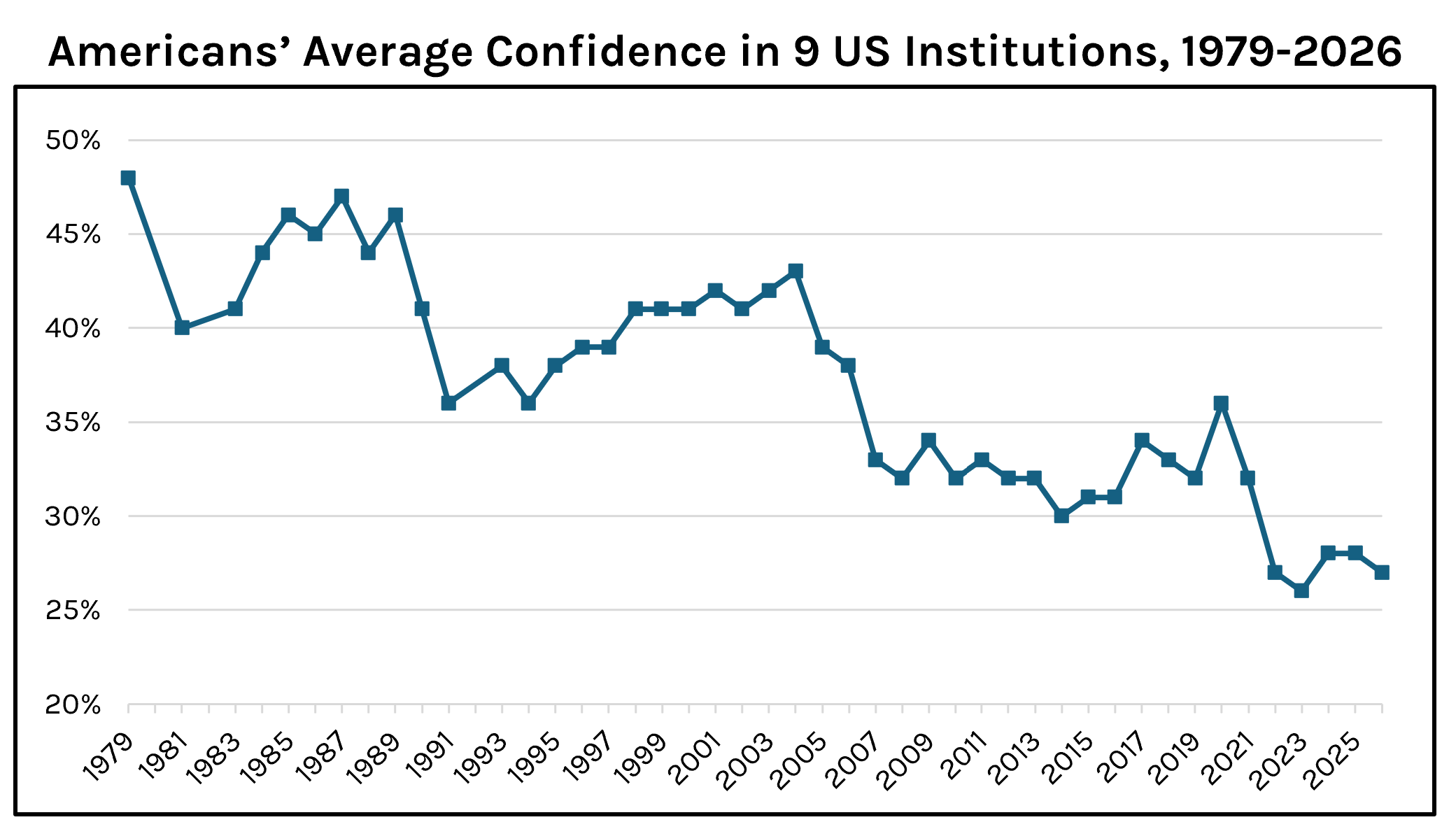
Since 1979, Gallup has measured Americans' trust in nine core US institutions, ranging from Congress and newspapers to organized religion and big business. In 2026, just 27% of U.S. adults said they had "a great deal" or "quite a lot" of confidence in these institutions. That's down -9 percentage points from 2020 (36%) and -21 percentage points from 1979 (48%).
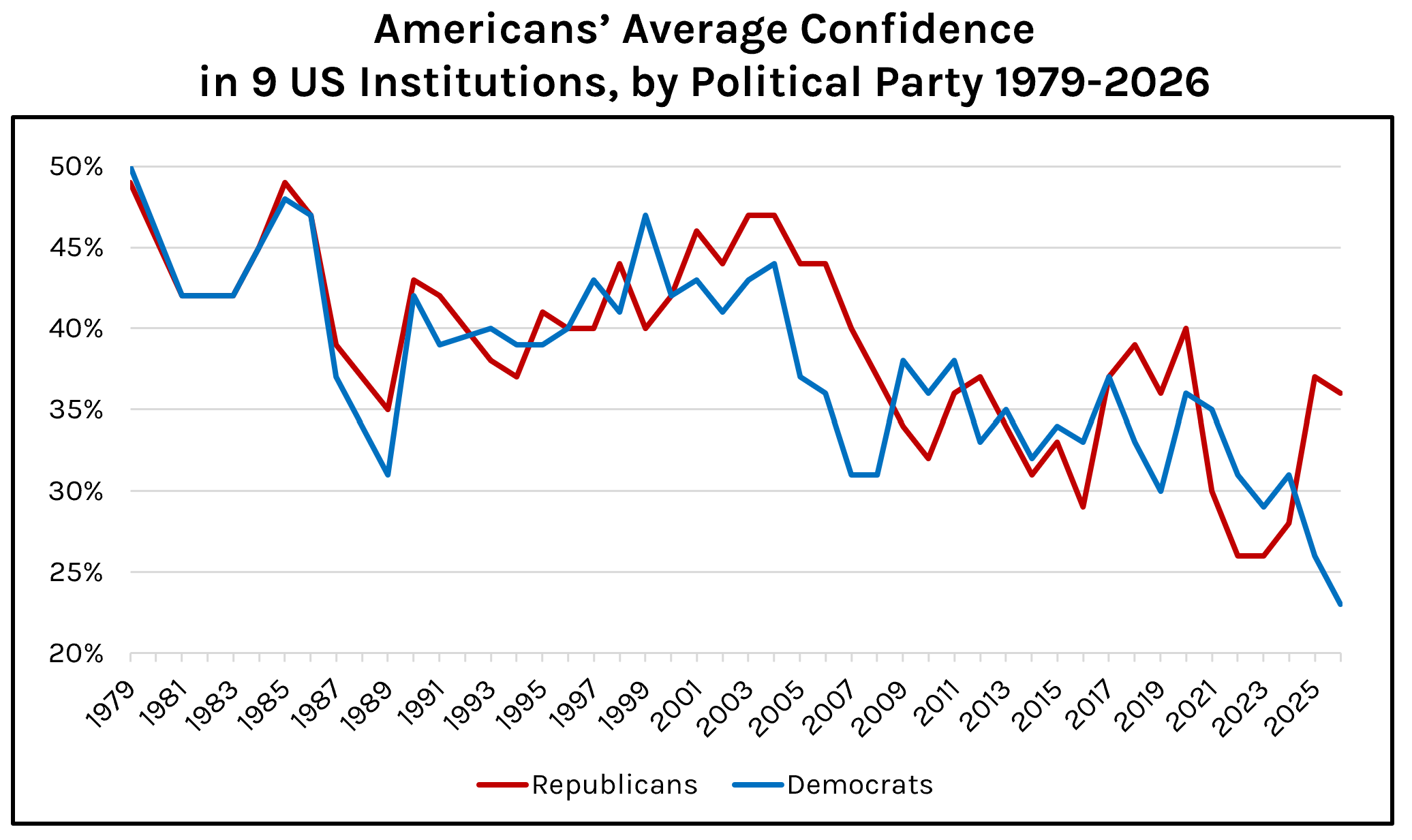
Between 1979 and 2000, Republicans and Democrats held largely similar views. But beginning in 2001, confidence started to diverge depending on which party controlled the White House. Republicans expressed greater confidence during the Bush and Trump administrations, while Democrats were more confident during the Obama and Biden administrations. Today, Republicans are the more confident of the two groups (36% vs. 23%), and the partisan gap has reached a record 13 percentage points.
This survey simply confirms what we've been documenting for years: American pessimism is high, institutional perceptions have become increasingly partisan, and yes, the Fourth Turning is here. (See “Trust in US Institutions Remains Low.”)