



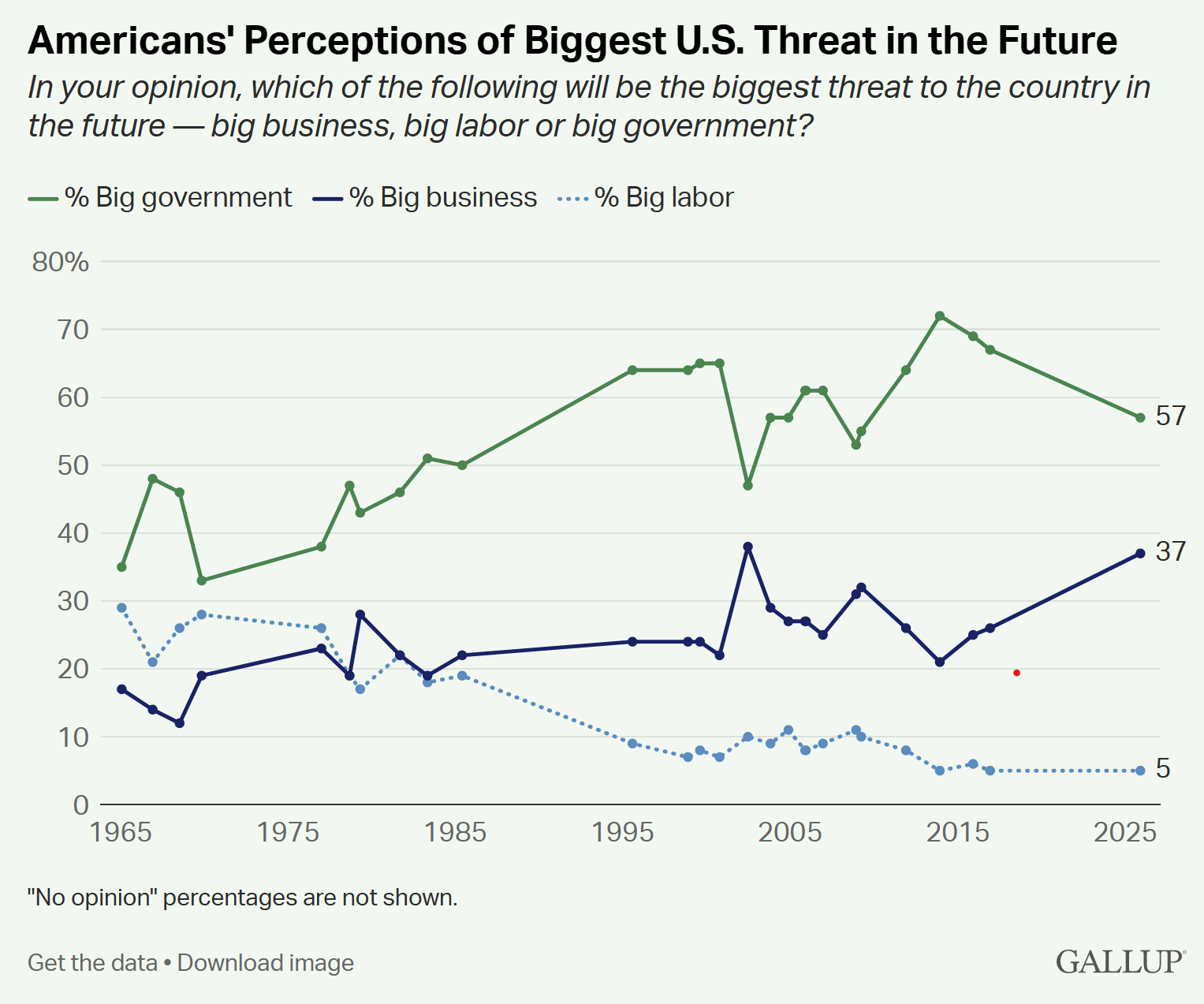
What Americans see as the nation’s greatest threat is changing. Big government still tops the list, but concern is steadily shifting toward big business.
Since the 1960s, Gallup has asked Americans which force poses the greatest threat to the nation’s future: big government, big business, or big labor. But over the past decade, a clear shift has emerged.
While big government remains the top concern, the share naming it has fallen sharply, declining -15 percentage points to 57%. At the same time, concern about big business has surged, rising +16 points to 37%. Views of big labor have remained largely unchanged, holding steady at just 5%.
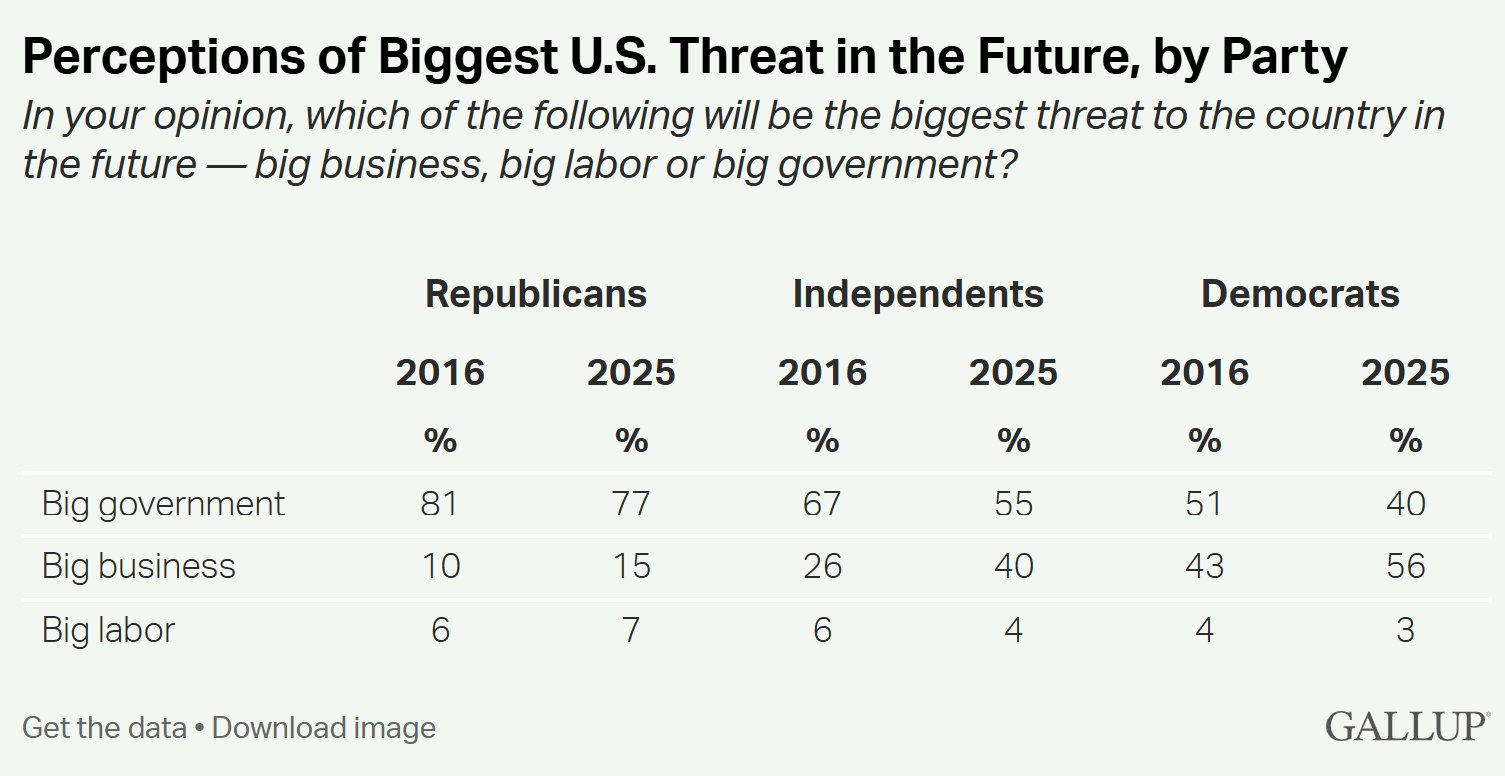
Since 2016, every major political group has recorded a decline in the share saying big government is the nation’s top threat. But the steepest drop has occurred among independents (-12 points), followed by Democrats (-9 points) and Republicans (-4 points). The same pattern appears in rising concern about big business. Independents have posted the largest increase (+14 points), followed by Democrats (+9 points) and Republicans (+5 points).
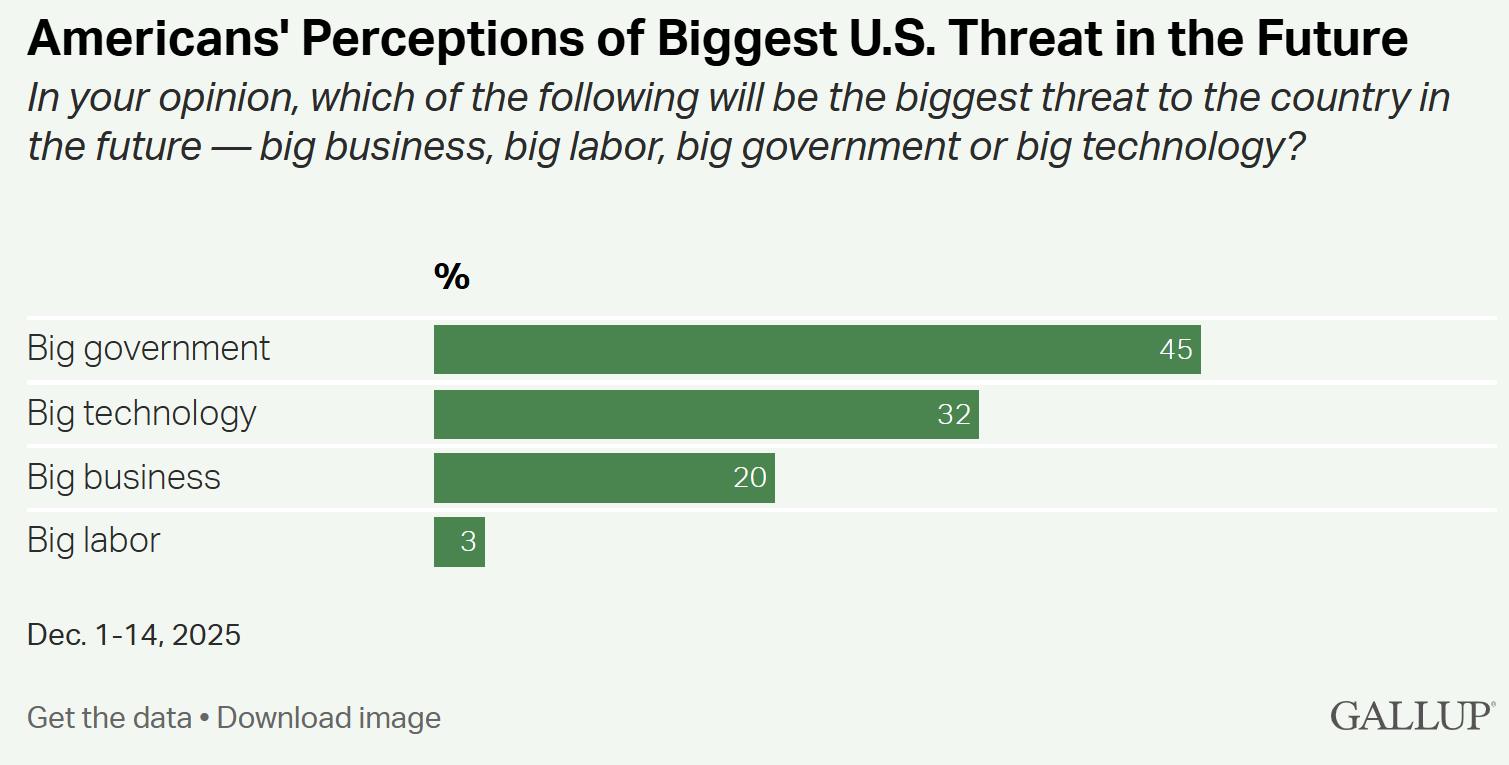
When big tech was included as a response option, 32% of Americans identified it as the greatest threat. Views were relatively similar across party lines, with 34% of independents and Democrats saying big tech posed the greatest danger, compared with 27% of Republicans.
These survey results are hardly surprising. In recent years, both parties have shifted toward more populist agendas, many of which require a stronger and more interventionist government to implement.
On the Democratic side, this shift is marked by the rise of figures such as Bernie Sanders, Alexandria Ocasio-Cortez, and more recently Zohran Mamdani. On the Republican side, the MAGA movement has embraced an America First agenda showcasing economic nationalism, industrial policy, and even state ownership of large firms. In our most recent podcast episode, we break down Donald Trump’s latest populist proposals, including caps on credit card interest rates and new restrictions on institutional homebuyers.
We have also published several NewsWires on the growing tech-lash. Here is one of the few agendas where both sides of the political aisle find common ground. (See “Tech-Lash Intensifies” and “Americans Don’t Trust Big Tech.”) At the same time, we have examined multiple surveys showing rising public support for organized labor, despite union membership hitting all-time lows. (See “Union Support Rises.”)
For the growing number of populist voters in both parties, big business has emerged as a convenient and unifying villain.
I'm wondering if the populist sections of the progressives (Sanders/AOC) and MAGA (Vance) may have an eventual political convergence.