



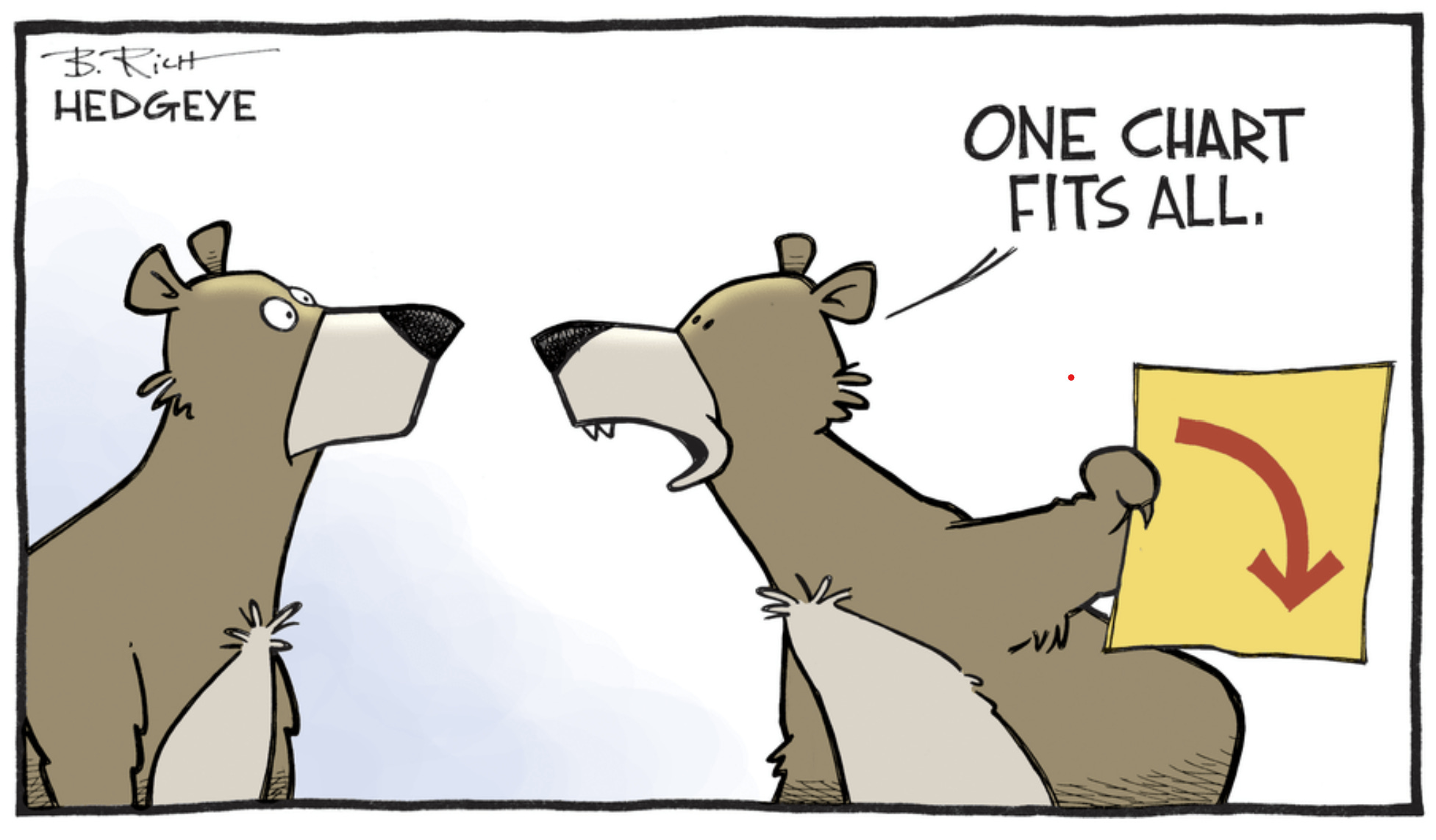
A new survey highlights a sharp generational shift away from American exceptionalism. Young Americans no longer see US dominance as either inevitable or essential.
—Carnegie Endowment for International Peace
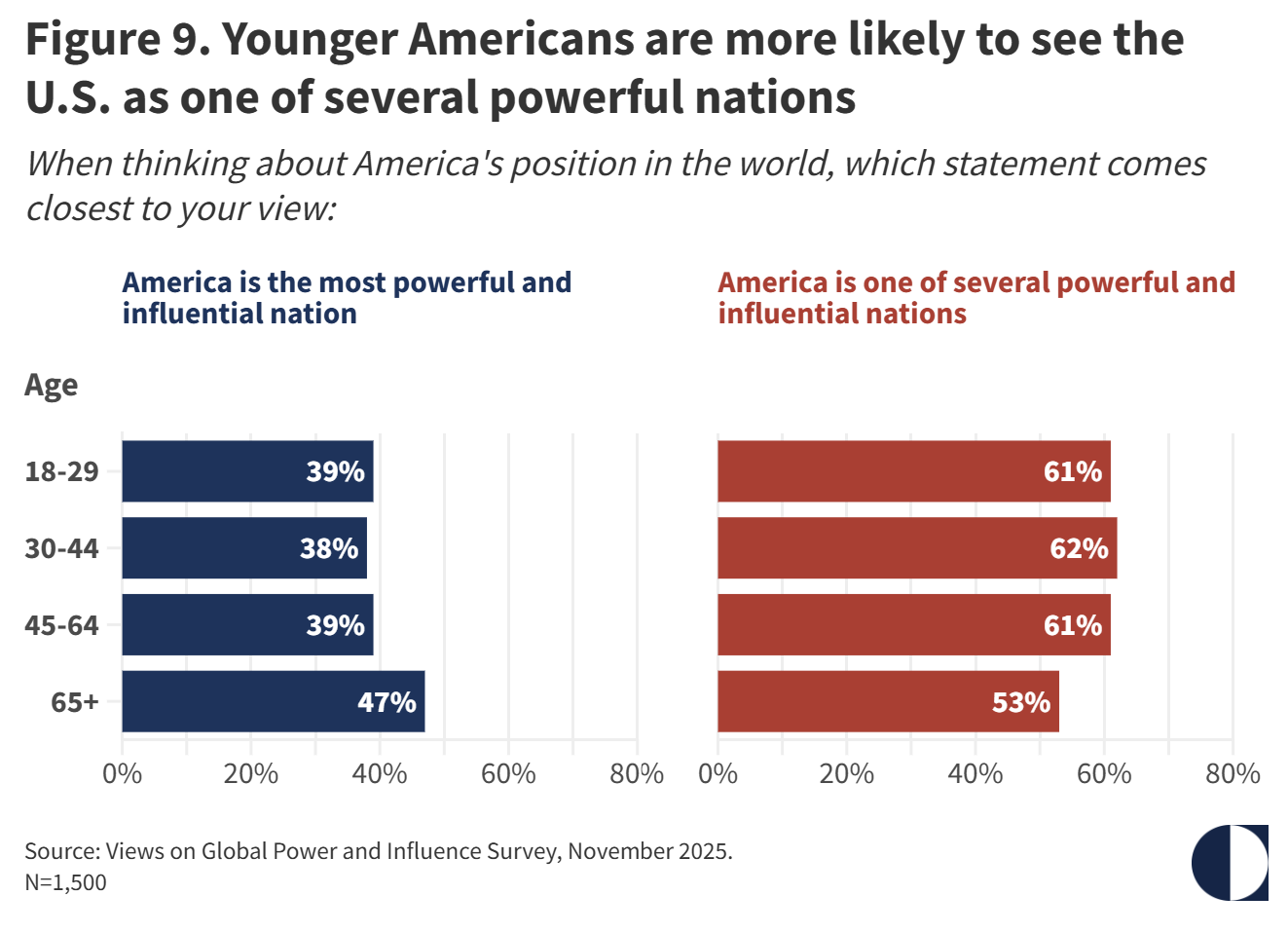
Belief in American exceptionalism is fading among younger generations. A new CEIP survey finds that only 39% of adults ages 18–29 view the United States as the world’s most powerful nation, compared with 47% of those ages 65+. That’s an 8-percentage-point gap. Instead, younger Americans increasingly see the US as just one of several major global powers.
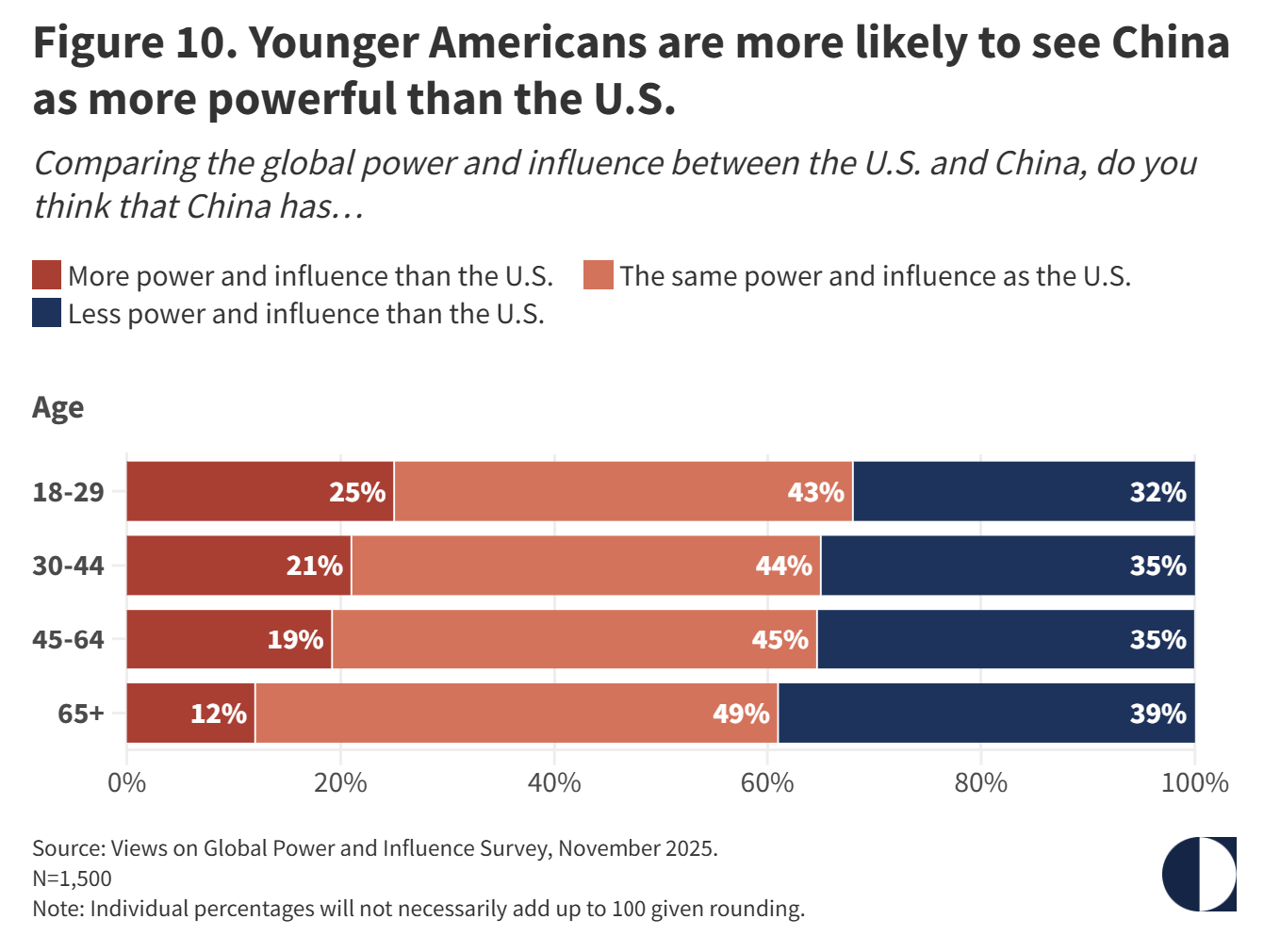
That shift is especially evident in views of China. Young adults are only slightly more likely to say that the US has more power and influence than China rather than the other way around (32% vs. 25%). Seniors are much more likely to put the US on top rather than China (39% vs. 12%).
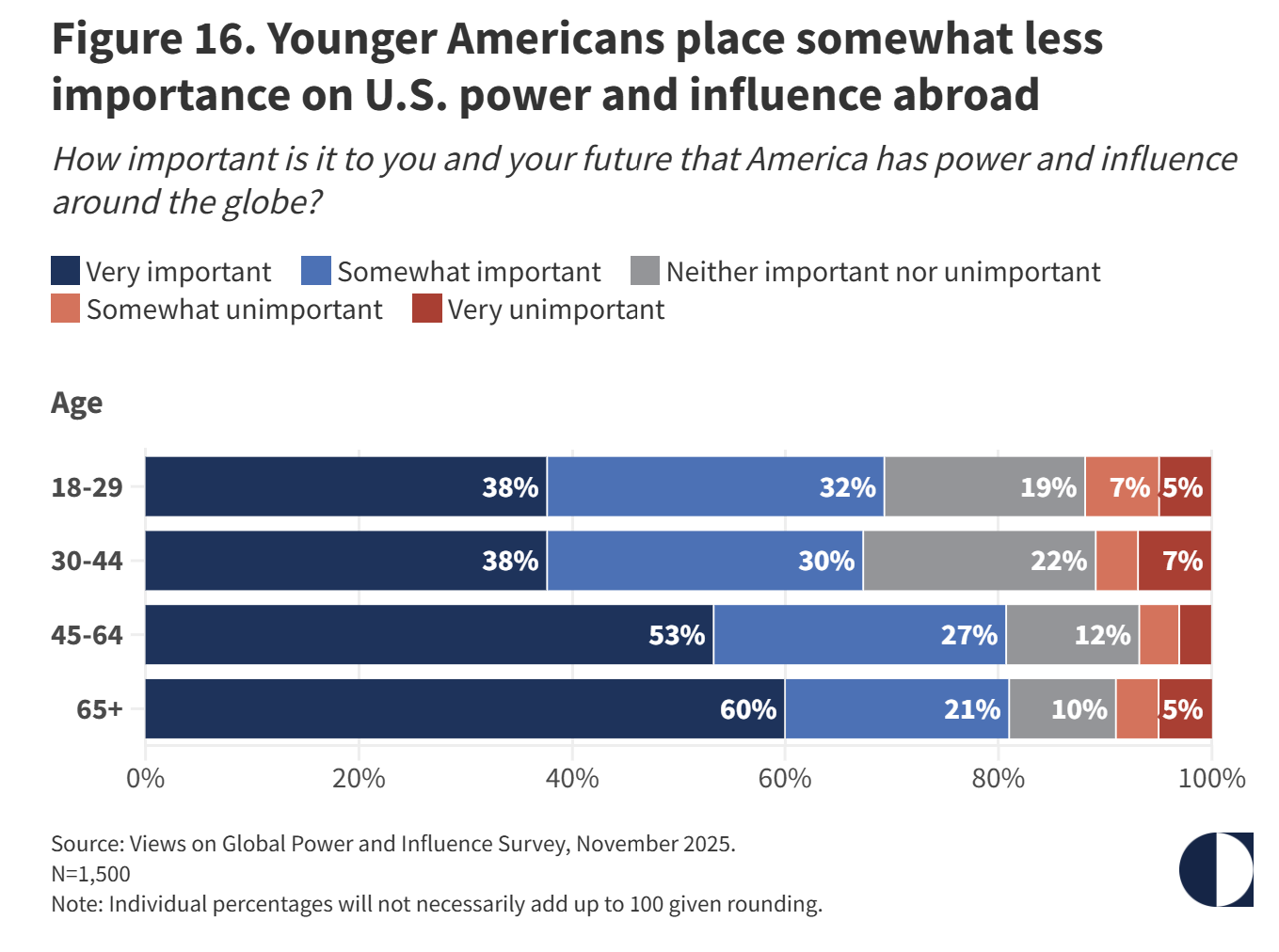
Overall, younger Americans care far less about US global dominance. Just 38% of adults ages 18–29 say it is very important to their future that “America has power and influence around the globe,” compared with 60% of those ages 65+. That’s a striking 22-percentage-point gap.
What explains this generational divide? For one, young Americans are deeply dissatisfied with government. Many believe their political leaders have failed to address the defining economic challenges facing their generation, such as housing affordability and student debt. More broadly, many feel politicians have failed to articulate what America aspires to become over the next ten or twenty years. If leaders were to articulate an exceptional purpose or vision that recruited the hope and energy of ordinary people, many young people might respond. But in the age of Biden or Trump, they hear nothing: Citizens aren’t needed. Just trust the experts—or the wrecking ball.
As a result, large numbers of Millennials and Homelanders view the United States as just another country that they happen to be living in. (See “Generation Hopeless: The Despair of Young Americans” and “Global Millennials: Down on Democracy and Drawn to Populism.”)
Generational memory also plays a key role. Younger Americans did not live through the Cold War, when US global leadership was framed as aspirational: America really did promise something better than the dictatorships. It was also framed as existential. It was widely believed that if our nation did not win, our nation would lose, and all of our allies would go down with us. Without that historical context, the imperative for American dominance carries less emotional weight.
I am a long-time follower and have used your FOURTH TURNING in my academic writing and presentations. I actually began using GENERATIONS to teach AP US History/Government in 1993 when my students all received 5s. Yes, I am seeing the same situation, but since my 14 year old grandson and his parents live with me, I'm able to monitor his and his friends' thoughts. Most still use binary thinking, so I hear their rejection of (crony) capitalism by leaning toward communism. I try to explain the delusions about communism from its active totalitarianism to him and to his friends, but that still leaves them with no guiding platforms to which to turn. I've explained the 4th Turning to them and explained it will be up to them if we get through this time of collapse and chaos. Any ideas as to how to direct these young ones?